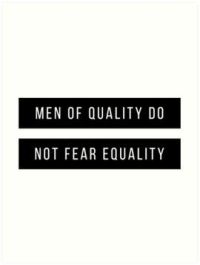
 The Bloke and I don’t fight often. We’ve spent the better part of twenty years happily muddling along, quietly delighting in our continued coexistence.
But every now and then — because we’re real, normal human beings — we have a bit of a barney. Generally speaking these arguments are not over anything particularly controversial (such as just how many surfboards/boogie boards/random vessels of an inflatable variety a family of four might actually require on a weekend away), but last night…well, it was a different story.
We were watching Nanette, Hannah Gadsby’s hour-long stand up show, a vertiable tour de force explaining why she is choosing to leave comedy behind. Nanette is, simply, brilliant: it is a brutally honest and unbelievably courageous piece of story telling. It is also, in parts, uncomfortable viewing — particularly if you’re a straight, white male who has just been watching Season Two of Glow, complete with its depiction of a Harvey Weinsteinesque “meeting” involving a young and vulnerable actress, and if you had also happened to top that experience off by taking a look at Andrew Denton’s Interview with Tim Winton (the one who wrote my favourite book) speaking about toxic masculinity.
Straight, white male.
Now we all know that the straight, white male segment of the population is copping a bit of a caning at the moment. With good reason, of course — and let’s be clear: in my view, there’s nothing wrong with challenging a long-established framework of white, male privilege that has been propped up by centuries of patriarchy and misogyny. And I, as a straight, white female, last night felt the need to point out that those structures were the very things that silently condoned straight, white men heckling or wolf-whistling at me when I was a schoolgirl, walking past a construction site at the top of the street I lived in. That allowed a crowded platform of commuters to stand by and ignore the straight, white man who tried to look up my skirt, and who failed to assist me when he followed me onto the train. That normalised regular pay increases for the (overwhelmingly) straight, white male professionals in several firms in which I worked and did not even bother to schedule salary reviews for the (overwhelmingly) female support staff. That continues to impose a tax on women’s sanitary products…but let me stop there. I could, as most women could, go on and on.
Straight, white male.
These were the words that sparked our disagreement, along with the onslaught being fairly and squarely directed at that particular segment of the population.
Because The Bloke identifies as a straight, white male — and, while I can’t dispute his logic, last night I also felt the need to point out that I don’t view him through that prism at all. I felt the need to explain that if he had been the sort of straight, white male who is currently — and with good reason — being called to account, I would never even have considered dated him, let alone marrying him. That I don’t believe him to be a misogynist. That I certainly don’t perceive him to be anything like Donald Trump.
I explained to The Bloke that when I look at him, I see a successful business owner who pays his male and female staff equally. I see a husband who consistently treats me as an equal in our life partnership. I see a father who is helping to raise two daughters to be the best human beings they can be. I see a person who frequently helps with housework and does not delineate duties on the basis of gender. I see a man who is willing to draw attention to language, attitudes and behaviours towards women that are unacceptable. I see a…feminist.
Feminist?!
Initially, The Bloke wasn’t quite sure what to make of that word, either, being aware of the many and varied connotations and convictions attached to it. But — because of the man he is — The Bloke listened to me and not only heard, but also made sure he understood my point of view.
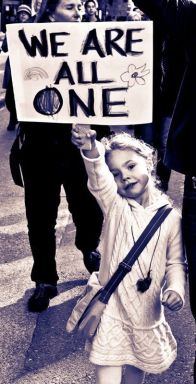 And that’s where Hannah Gadsby is absolutely right — we need more words, people.
We need a multitude of words.
We need more words to describe the men who might, quite literally, be straight, white males, but who are also men whose own language, attitudes and behaviours are helping to dismantle the architecture of straight, white, male privilege. Men who support and empower women and girls not because they are female, but because they are human beings, and who encourage other men and raise their sons to do just the same. Men who, in my life, I feel fortunate to call father, brother, mentor, friend.
We need more words to define the things that unite us and celebrate all the things we hold in common — not more labels, or pigeonholes, or tiny little compartmentalised boxes.
We need more words.
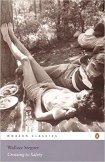 Crossing to Safety by Wallace Stegner (1987). This book was loaned to me by
  American Gods by Neil Gaiman (2001). What a rollicking good read! Normally I read housebrick sized books on my Kindle, but this one I lugged to and from Fiji and am so glad I did. The story of Shadow and Gaiman’s depiction of the battle between Old Gods and New in America is (literally) fantastic, eccentric and kept this
 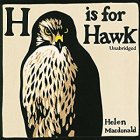 H is for Hawk by Helen Macdonald (2014). I’m not sure I’ve read any other book quite like this one — and while the subject matter (the author’s way of dealing with her grief following the death of her father) is not easy, Macdonald’s brutally honest emotional journey aligns more perfectly that I ever expected with a wealth of arcane knowledge of falconry and the life of T H White. I never anticipated I would find such subjects remotely interesting, but this book proved me entirely wrong.
 Our Souls at Night by Kent Haruf (2015). Oh…this story. Published posthumously, Haruf’s tale begins with an unusual proposition and ends up being an absolute joy to read. It’s bittersweet too, it’s true, but — in my view — ultimately uplifting. Like most purists, I suspect the book is better than the movie version, despite fact the film starred Jane Fonda and Robert Redford. Read the book first. Please. (You know it’s the right thing to do.)
 The Life to Come by Michelle de Kretser (2017). Winning this year’s Miles Franklin award, I can’t honestly say I enjoyed this book: the characters are eminently recognisable, particularly to Sydneysiders, but I did not warm to any of them. That said, there wasn’t a single other book I read all year that had my head wriggling like a tin of worms for so many weeks after I’d put it down. Oh — and the writing is seriously, utterly brilliant.

 Blue Jai: