
Huzzah! It’s the last day of winter here in the Antipodes, and there is already a hint of spring in the air.
I’m pushed for time today, so welcome to a rather express Edition of the THREAD – let’s jump in!
THINK | HEAR | READ | EAT | ADMIRE | DO

Strangely enough, I’ve been thinking about time management, and specifically about distractions. I’m one of those people who has been working from home since before the pandemic, and time management is something pride myself on being pretty good at. I think it’s also fair to say I’m experienced at navigating pathways between those devious, pesky things we call distractions — which can include anything from finding yourself suddenly possessed by an unscratchable urge to perform a chore you would otherwise find mind-numbingly boring, playing games on your phone or laptop (I’m looking at you, Wordle), or gazing blankly into the refrigerator until the annoying door alarm starts going off. Been there, done that, sent them all packing.
But when the first glimmerings of spring appear, I often want to get out amongst it instead of sitting at my desk. So this week, when my schedule was unexpectedly upended by a cancelled work placement, I’ve concentrated on putting all the things in all the boxes so I can create spaces in between where my writing can flow. I find that if I can plan out and “Tetris” all the stuff — from personal training, to kids’ extracurricular activities, to menu planning, to lunch with a friend, and even the many and various things seeking to distract me — the time I free up becomes…well, free. And when I’m free, the words can come in waves. I guess what I am trying to say is if you know yourself well enbough to identify your patterns of behaviour you can conquer any distractions, and my way of doing that (however incongruent it may sound) is by using boxes and waves.

Except sometimes things don’t go willingly into a box, which is where hearing comes in handy. Most parents know that if you sing something to a child, it becomes somehow more palatable — or maybe more like a game. Either that, or we’ve all been looking like complete loons while walking around messy living rooms singing “now it’s time to pack away” in happy, hopeful tones to our offspring. I’ve written before about how hard it is to stay cranky with your kids, for example, when you’re listening to disco music. Please give it a try if you don’t believe me — and remember, no matter how small or large, all kitchens are for dancing in.
Anyway, the same principle works for me when I’m struggling with adulting and feeling rather petulant (OK…I”ll admit it, downright childish) about it. If I’m not in the mood to go to personal training during the precisely allocated box I have timetabled for myself, for example, I put Madonna’s Ray of Light on in the car on the way to the gym and turn it up LOUD. If I can’t get into the right headspace to write, I try Ralph Vaughan Williams’ The Lark Ascending. It’s still boxes and waves, really — just in musical form.
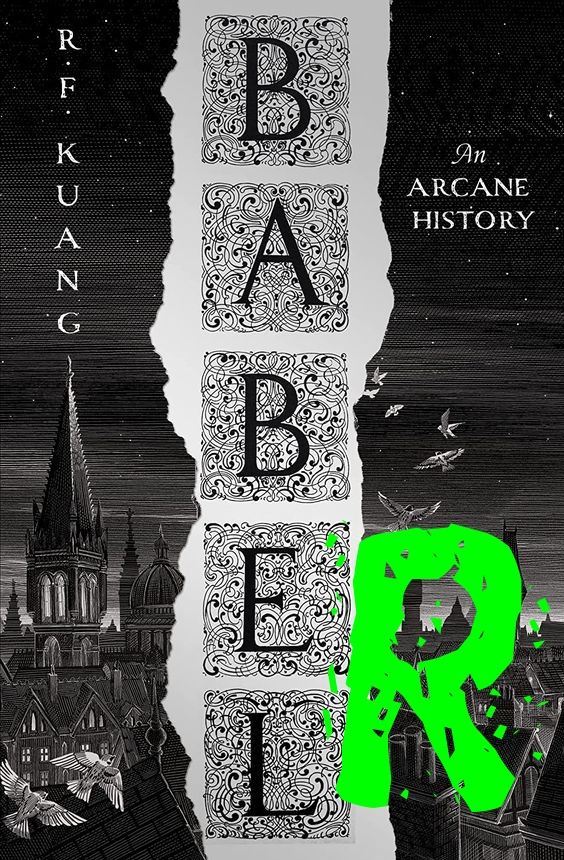
Reading is something I don’t usually have to put in a box, because I tend do it at the end of the day when I’m all snug in my PJs and ready for bed. But when I’m really busy and just want to hit the pillow at the end of the day, I find other boxes that allow me to fit my reading in — like when my daughter has her flute lesson. In this way, I’ve managed to read R F Kuang’s Babel, or the Necessity of Violence: An Arcane History, which is a fantastical historical novel my language loving father would have loved back before dementia robbed him of the ability to read. It’s a complex book dealing with equally complex themes (imperialism, colonialism, revolution, and how all of these intersect with academia), but at the centre of it all is the concept of translation. I wanted to love this novel, but found it kept me somehow at arms length — possibly because of the extensive use of footnotes (which may or may not be historically accurate, as it is a work of fiction after all), or maybe as a result of it’s scholarly tone. Did it remind me of the way I had to read when I was at university (which often for anything but pleasure)? Perhaps. That said, while I didn’t love it, I did enjoy it, and was glad to have read it.
Since then, I have started reading Pip William’s latest offering, The Bookbinder of Jericho. It is much easier going but so far it hasn’t engaged my attention to the point where I want to pick up the book instead of laying my head on the pillow…though I suspect says more about the nature of my life lately, rather than about the novel itself.

Our next topic — and also a great form of distraction — which is eating, and the simple story here is that I have been trying not to eat when I shouldn’t. As in I am still working on eating sensibly and only at mealtimes (after my peviously-reported tropical island gluttony), and so far this approach is working well.
Tonight we will have chicken schnitzel with a roast pumpkin salad, which involves not only the aforementioned pumpkin spiced up with some cumin and coriander, but also corn and black beans, toasted pepitas and a lime crema dressing. It’s delicious, and full of flavour. Tomorrow night it’s meant to be cold again — because spring is always a bit of a tease — so we will have roast lamb with baked vegetables and greens. Beyond that our meals are a bit of a mystery, but I’m sure all will become clear once I reach the appropriate box in which menu planning has been scheduled?!

When it comes to admiring, I managed to find time to watch Netflix’s latest offering in the Bridgerton franchise Queen Charlotte last week. It has all the usual Bridgerton fancies and follies: over the top costumes in riotous colours, wigs so resplendent they would make any self-respecting drag queen swoon, a smattering of sex scenes, and classical musical renderings of pop songs. But Queen Charlotte also has, at its heart, a beautiful and moving story of a couple living with and divided by mental illness. As someone who has witnessed the various ways generations of my family have dealt with living with bipolar disorder, I was genuinely moved by the depiction of the relationship between Queen Charlotte and King George III — and I am grateful that the producers of Queen Charlotte chose to tackle the subject matter rather than shying away from it. Mental illness can affect anyone, from commoners to kings, and I’m glad to see it being presented on screen rather than hidden away.

And finally, that brings us to doing. I’ve been doing rather a lot, hence all the boxes (and hopefully plenty of waves in between), but like rest of the Australian population there is one thing I have stopped everything else to do in the past month: watch our mighty Matildas play in the World Cup. While my knowledge of anything soccer-related is similar to that of Ted Lasso when he started out at Richmond FC — as in I can’t explain the offside rule but I think I know it when I see it?! — like most Australians I love sport (generally) and am now completely in love with the Matildas (specifically). And I do mean ALL of them, though I do have a particular soft spot for Mackenzie Arnold and think Hayley Raso’s hair ribbons are the bomb. I will never, ever forget the way I felt when Sam Kerr scored that amazing goal against the Lionesses, and I am inordinately proud — along with the rest of the country — of what the Matildas have done not just for women’s sport but for women in Australia and beyond.
Anyhoo, there’s no real topping the Matildas is there?
So best to wrap this up and attend to the next box full of “stuff”.
Mind yourselves,
BJx

 I have
  Later, with the encouragement of a wonderful teacher who let me take home various school instruments over the holidays, I taught myself clarinet. That teacher was always challenging me, inviting me to audition for an all city concert band I never thought I would get into, then pushing me further by naming me Principal Flute player of that ensemble — never doubting that I was capable of leading my section — and handing me a piccolo, which I’d never played before, with an offhand remark along the lines of, “Don’t worry, you’ll pick it up in no time; just get yourself a book of Irish folk tunes and you’ll be fine.”
 Blue Jai: