The Writing on the Wall

Graffiti Sirens

“Sirens” by Hush

Unsanctioned.

Unauthorised.

Unendorsed.

Why do all these words sound less offensive than illegal?

See here’s the thing: I love street art.

I’m not referring to the mindless repetition of a single tag across a public space — that’s about as impressive as a dog pissing to mark its territory.

I mean consciously created visual artworks.

On walls.

Walls that belong to other people.

Graffiti, from written words to wall paintings, has been around for thousands of years. The ancient Egyptians did it, so did the Greeks. Any visitor to Pompeii would know that the Romans were bandits for it. From Ephesus in Turkey, to Tikal in Guatemala, to Sigiriya in Sri Lanka, people across antiquity have left their marks on walls, painted for posterity, or more likely scratched — which is, of course, the meaning of the Italian word graffiato, from which graffiti got its name.

Blue Bird by the elusive Banksy

“Girl with Bluebird” by the elusive Banksy

In modern times — particularly since the advent of the aerosol can — graffiti has been taken to a whole new level, raising it from vandalism to art. Part of street art’s appeal is that it is subversive: its very presence is usually illicit but, by virtue of its accessibility, it is able to elicit a response from the broader population. Street art is often political. Provocative. Daring. It’s bold and it’s brave and, despite its illegality, it can also be downright beautiful.

Street art is also intriguing because some of its greatest practitioners are shrouded in secrecy. From 1932 to 1967, Sydneysiders would awake to see the work of Arthur Stace wherever he chalked the word “Eternity” in elegant, Copperplate script on pavements throughout the city. During the course of his life Stace is estimated to have produced the word around 500,000 times, writing his way into popular culture as he did. His identity was eventually made public in 1956, but his work was immortalised when the word Eternity was illuminated on the Sydney Harbour Bridge at the 2000 New Year’s Eve celebrations.  The image was used again during the Opening Ceremony of the Sydney Olympics later the same year.

Blek le Rat's "Ballerina"

Blek le Rat’s “Ballerina”

More recently, Blek le Rat — one of the originators of stencil graffiti — produced his work anonymously in Paris for a decade before he was identified (and arrested) by French police in 1991 as he stencilled a replica of Caravaggio’s Madonna and Child on a wall. His style is distinctively Parisian, frequently depicting dancers and musicians, as well as style icons like Diana, Princess of Wales. Since 2006 Blek le Rat has held exhibitions of his work in galleries around the world, but has expressed his preference for working in the streets where it can be seen by a much wider audience than in a gallery.

The identity of influential Britsh street artist Banksy remains a closely guarded secret, despite numerous claims by various newspapers that they have discovered who he is. Banksy’s stencil art is often satirical, politically charged, and wickedly funny. In the words of Shepard Fairey, “Banksy paints over the line between aesthetics and language, then stealthily repaints it in the unlikeliest of places. His works, whether he stencils them on the streets, sells them in exhibitions or hangs them in museums on the sly, are filled with wit and metaphors that transcend language barriers.” Like Blek le Rat, however, Banksy also prefers to use the street as his canvas, stating that “when you go to an art gallery you are simply a tourist looking at the trophy cabinet of a few millionaires”.

My dining room wall.

A metal print of Birgit Kinder’s “Test the Rest” on my dining room wall…complete with extra graffiti. The original has been repainted multiple times since it was first produced in 1990.

One of my favourite pieces of street art now hangs on our dining room wall — a metal print of a Trabant 601 breaking through the Berlin Wall from the famous East Side Gallery, a 1.3km-long section of the wall on Mühlenstraße in Freidrichshain-Kreuzberg that has been described as a memorial to freedom. Another metal print hangs in our hall, a montage of graffiti from various sections of the Berlin Wall before it came down on 9 November 1989.

And that’s where I think the lines of street art begin to blur: when it begins appearing on walls in suburban houses, or when its production has been given public approval.

Sanctioned.

Authorised.

Endorsed.
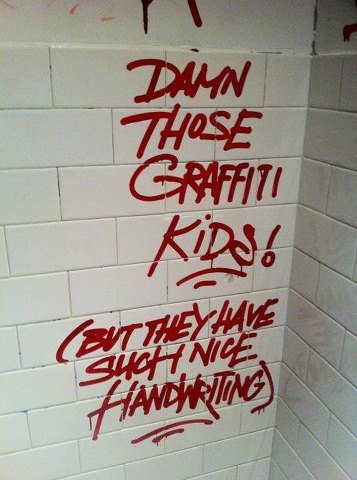
Damn graffiti kids...

Damn those graffiti kids…

I remain torn between wanting to take my kids to see the gigantic Kosmonaut mural Victor Ash painted in Kreuzberg in 2007, which has — unsurprisingly — become a Berlin landmark, and wishing they could simply explore the city and discover the incredible urban art that has been created without approval.

Because that’s the thing about street art. You can hang it on your wall, you can stick it on a Pinterest board, but the best kind will always be the piece of graffiti you stumble across on the street — the one that the artist has put there to communicate directly with you and whoever else sees it.

On walls that belong to other people.

Out in the open.

Free.

In Praise of Pluto

Eris.  Ever heard of it?

Didn’t think so.

Eris is the reason Pluto — poor old Pluto — is no longer deemed worthy of being called a planet.

Horsehead nebulaIn the good old days (otherwise known as the Eighties), we learned about the solar system in school. Back in 1986, the reappearance of Halley’s Comet was not treated as a harbinger of doom, but as an unmissable opportunity to foist random space facts onto unsuspecting school aged children that was too good to miss. In educational parlance, it heralded the arrival of a “teachable moment” in gloriously action-packed colour, and our lessons were filled with tales of the Milky Way, black holes, quasars, nebulae (the Horsehead Nebula was a particular favourite), red dwarfs, Magellanic clouds and — of course — the planets. All nine of them.

Nine planets — just like the Nine Nazgul in Tolkein’s trilogy, or the nine circles of hell in Dante’s Divine Comedy. We even had a mnemonic to remember them, in order of their proximity to the Sun: My Very Elegant Mother Just Sits Under New Potatoes. (Admittedly, like many mnemonics it doesn’t make much sense, but the critical factor here is the presence of Potatoes…er, I mean Pluto…at the end, way out in the darker reaches of the galaxy).

But then in the early Nineties, Pluto’s planetary status started to wobble. Astronomers discovered the Kuiper belt, a ring of objects way out past Neptune. Big objects. Dark mutterings began to be heard in astronomical circles, that Pluto — named for the God of the Underworld, no less — was only a dwarf planet.

And then, in January 2005, a new body was discovered. And this object, as it turned out, was bigger than Pluto.

Yep, you guessed it: Eris.

In one fell swoop, Eris — appropriately named after the Goddess of Strife and Discord — sent Pluto packing from the planet list, relegating it to the ranks of TNO’s (Trans-Neptunian Objects) and forcing the International Astronomical Union to come up with a formal definition of “planet” at a conference in the Czech Republic in 2006. And while the cynic in me suspects that all those stargazing scientific types really wanted was a good excuse to visit Prague, the upshot of their Eastern European sojourn was that Pluto was down-graded. Reclassified. Failed to pass the planet test.

To say the decision to strip Pluto of planetary status was controversial would be an understatement — even in astronomical circles.  Apparently less than 5% of astronomers voted to support the new definition, which could hardly be construed as a representative sample in any dictatorship democracy. I, for one, would agree with Alan Stern, who asserted that “the definition stinks, for technical reasons” (and if you’re similarly inclined, you can read about why here).

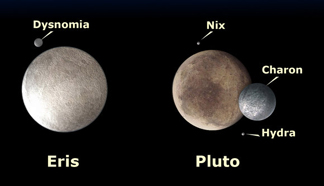
eris_pluto

This image comes from a Northern Arizona University article discussing their involvement in investigating the surface of…you guessed it…Eris.

Apparently, Pluto does not meet Criterion 3 of the IAU’s definition of planet: that the object “must have cleared the neighbourhood around its orbit”.

I mean, seriously people — is that it? If clearing the neighbourhood is all they needed Pluto to do, surely we could have sent someone out there to sort it out? The US Marines, perhaps? The French Foreign Legion? Hell, I think even the New South Wales Police Force would be happy to take on the task of clearing a neighbourhood.

To be fair, I do understand that the IAU had something more along the lines of gravitational dominance and of there not being other bodies of comparable size other than its own satellites in the vicinity — and let’s face it, Pluto is light years ahead of Earth on the satellite front, with five moons to our one. But even when the scientific definition is considered, the celestial finger is still pointing in one direction, and one direction alone: towards Eris. Because Eris is the body of comparable size to Pluto that stops it from clearing the neighbourhood.

My Very Elegant Mother Just Sits Under New…

Sigh.

But now, finally, true believers around the galaxy are being rewarded for our continued faith in Pluto: our favourite former planet is making headlines once again.

More than nine years after its launch (yes, nine…there’s that number again), NASA’s New Horizons mission, tasked with understanding the formation of the Pluto system and the Kuiper Belt is rapidly approaching its destination. At the time of writing this, there are less than four hours before the New Horizons spacecraft flies closest to Pluto, when it will be only 12,500km from the Plutonian surface. The images the spacecraft will send back to Earth will be the first we have ever seen — which is arguably the most exciting thing to have occurred on July 14 since the storming of the Bastille in 1789.

I can’t wait to see those pictures!

Though I would imagine that Alan Stern, the aforementioned Defender-of-All-Things-Plutonic, is pretty keen on seeing them too. After all, he is the principal investigator on the New Horizons mission.

A Winter’s Tale

Southern CrossThe Winter Solstice has just slipped past down here in the Southlands, and with it the shortest day.  It’s about as cold as it ever gets in Sydneytown, when the sun dips down before dinnertime and the stars swing overhead in the early darkness, pricking tiny silver holes in frosty skies.  The Southern Cross shines brightest in the winter sky.

Winter.

Some say we don’t know much about winter, down here in the Antipodes. It’s not like we need to don down jackets just to pop out to the shops, and any child sporting a pair of earmuffs is probably impersonating Anna from Frozen rather than protecting their extremities from the cold. But having spent two years living in Canada, in a city on a more northerly latitude than Moscow where winter lasted the better part of eight or nine months, I can honestly say I have felt colder in Sydney than I ever did in Edmonton.

Sydney cold seeps.

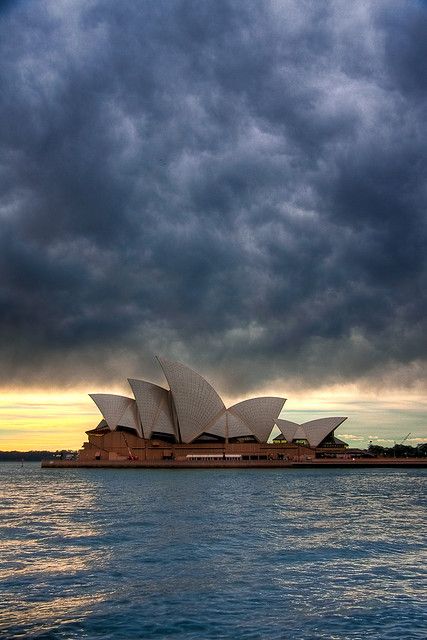
Sydney stormIt gets into your bones. It is dank and it is damp. It rides in on southerlies, straight off Bass Strait, and settles into every exposed crevice. It saps and it leaches. It is persistent.

Winter weather in Sydney is a petulant child: sunny one moment and sulky the next, or threatening to storm before suddenly showing off, throwing ridiculously perfect rainbows and breathtaking beautiful sunsets skyward as twilight descends. It makes us stamp our feet and rub our hands, yet takes great delight at seeing our breath emerge in great clouds of white when we speak into the chill.

In wintertime, we seize the days of sunny splendour that remind us that summer does return to our city, we grasp them and will them to last.  We retaliate against unexpected rainstorms by buying yet another umbrella when the weather catches us out. Again.

But when the wind blows and the temperature drops, we often retreat.

As Edith Sitwell once said, “Winter is the time for comfort, for good food and warmth, for the touch of a friendly hand and for a talk beside the fire: it is the time for home.”

In WinterIn winter, we wrap our fingers around warm cups of tea. We roast and we slow cook. We bake. We pull portable heaters out of their hiding places. We wear ugg boots anywhere we think we can get away with it, and even in some places where we can’t. We curl up with books under blankets. We indulge in marathon Netflix sessions. We curse the fact that Season Three of Crossing Lines is still in post-production because we’re running out of episodes of Tom Wlaschiha…er, sorry, of Season Two…

And, somewhere in the midst of all our burrowing under covers, swapping recipes for soup, and muttering the motto of House Stark, there comes a point when Sydneysiders start to smile. It’s a strange and subtle tipping point, that begins with a slight upturning of the corners of the mouth, and usually ends up resembling a smug grin.

Because the secret to surviving a Sydney winter is very simple: all you need do is remember that around here, winter doesn’t last all that long.

And, besides, as Anton Chekov said: “People don’t notice whether it’s winter or summer when they’re happy”.

Tonight Again

Guy Sebastian rocking Vienna at Eurovision 2015

Guy Sebastian rocking Vienna at Eurovision 2015

So Australia has had its first official foray into the weird and wonderful world of Eurovision! Not that we needed any encouragement — Eurovision (and the drinking games that inevitably accompany the broadcast here in the Antipodes) has been part of our national consciousness for years. Seriously: wind machines, leather pants, glittery capes, big hair, bigger vocals, throw in the obligatory key change at the end of a song and what’s not to like? Raise your glass — it’s a winner in any Australian living room.

When it comes to Eurovision, Australians might even claim to be early adopters. Or maybe just a nation of immigrants, shamelessly trading on their (increasingly distant) European heritage.  At our haus — sorry, “house” — we always barrack for Germany purely because our last name is of German origin. Never mind the fact that our ancestors migrated from Bavaria prior to the First World War, and that the last person on either side of our family who wasn’t born in Australia was my Welsh grandmother who moved here before the Second. When Eurovision is on, that’s all irrelevant — Deutschland über alles! “Black Smoke” — awesome song! Someone give them another twelve points!

Stig Rästa: he probably should have woken her up...

Stig Rästa: he probably should have woken her up…

That said, we’re always keen to point out any kind of Australian link — no matter how tenuous — to anyone performing at Eurovision.  Didn’t you know? An Australian was responsible for designing the glittery beadwork on the Estonian back up dancer’s costumes. Yes, just that shiny little lightning bolt section, an Aussie did that.  Oi! Oi! Oi! (Not true of course…Estonia didn’t even have back up dancers this year — they didn’t want to distract anyone from Stig Rästa’s smoulder).

But this year, thanks to the generosity of the Austrians we are so often confused with, Australians didn’t have to search for questionable connections to the performers gracing the stage: we got to compete. And while quite a large part of me suspects that an auto-correct error might still be responsible for Guy Sebastian rocking out in Vienna over the weekend, Australians love a wildcard entry into just about anything. Eurovision 2015? Why not? I haven’t been to Austria since that Contiki tour back in…whenever…and besides, it’s only been two months since Mardi Gras, so I still know where my feather boa is! Eurovision 2015! Bring it on!

Guy Sebastian, it must be said, did Australians proud. What a song! What a legend! Our very own Australian Idol took the weight of a nation’s hopes on his shoulders and shot us straight into fifth place. And Aussies everywhere are now patting each other on the back, telling each other that we clearly had the best song and probably should have won outright, but we wouldn’t want to embarrass our hosts or show up an entire continent, now, would we?

Or course, coming fifth means that we did not win the right to host Eurovision next year, which is probably the only way we would have been allowed to compete in the contest again. At least we used our one and only wildcard entry to remind the world once and for all that despite our unusual accent and tendency to refer to our country as “Straya”, there is actually an “L” in “Australia”, and our country is not a landlocked state squeezed in between Switzerland and Slovenia, but is an island nation occupying our very own continent instead.

The inimitable Conchita Wurst...who would fit right in on Oxford Street. Yet another reason why Australia should be admitted to the Council of Europe...

The inimitable Conchita Wurst, green room host of Eurovision 2015. She’d fit right in on Sydney’s Oxford Street. Surely that’s another reason why Australia should be admitted to the Council of Europe…

And so, thanks to heroic (sorry, couldn’t resist) efforts of Måns Zelmerlöw, Eurovision will be heading to Sweden in 2016. I say that gives us twelve months to scour the contest rules to find some loophole that will allow Australia to become an active member of the European Broadcasting Union or the Council of Europe. In fact, the federal government should probably provide SBS with the funding to establish a whole new department (based in, say, Malmö…can’t think why…) to ensure Australia’s admission into Eurovision forever after. If Israel pulled it off, surely we can too?

Meanwhile, in Vienna, it’s time to pack away the smoke machines and send the capes off to the dry cleaners. Eurovision 2015 has been one for Australians to remember. And as Guy sang, this is one tough act to follow.

Forget tomorrow, we can do tonight again.

What a Piece of Work is Man

RememberWhat a piece of work is a man, how noble in reason, how
infinite in faculties, in form and moving how express and
admirable, in action how like an angel, in apprehension how like
a god! the beauty of the world, the paragon of animals—and yet,
to me, what is this quintessence of dust?

Hamlet Act 2, Scene 2, lines 303-307

Today marks the anniversary of my grandfather’s death.

I have lived more than half my life without him, but there are days when I feel his loss as acutely as I did all those years ago.

My grandfather’s passing is, for me, inextricably linked with Shakespeare, specifically with Hamlet, which I first saw performed the day he died. So much of what the play explores resonates with me, then and now — the grief, the family torn apart, the musings on life and how to live it, or indeed whether to live it at all.

Hamlet’s soliloquies are among Shakespeare’s most famous. More than four centuries after he wrote them they are known the world over, often quoted and occasionally parodied. Keenly observant of the mind’s workings, Shakespeare never allows Hamlet to shy away from confronting his inner demons, and his words provide insights that are surprisingly fresh and relevant today. And yet, when life — or life’s sudden, unexpected end — overlays these monologues with memory, embroiders them with poignant and painful detail, Hamlet’s orations become imbued, for me, with much deeper meaning.

Who was my grandfather, the quintessence of dust I lost more than two decades ago?

He was but a man.

He was of average stature, but with a presence so immense that its absence left a gaping hole. His smile lit up any room, his laughter filled any void.

He was a passionate sailor, a successful businessman, an avid tennis fan, and a hopeful punter.

He valued honesty, loyalty, persistence and discipline.

He believed wholeheartedly in the capacity of a decent cup of tea to solve any problem.

He enjoyed words — reading them, writing them, hearing them. He was a prolific and witty correspondent; his handwriting was simultaneously elegant and bold. He gave me my first dictionary, my first thesaurus. He taught me to appreciate brevity.

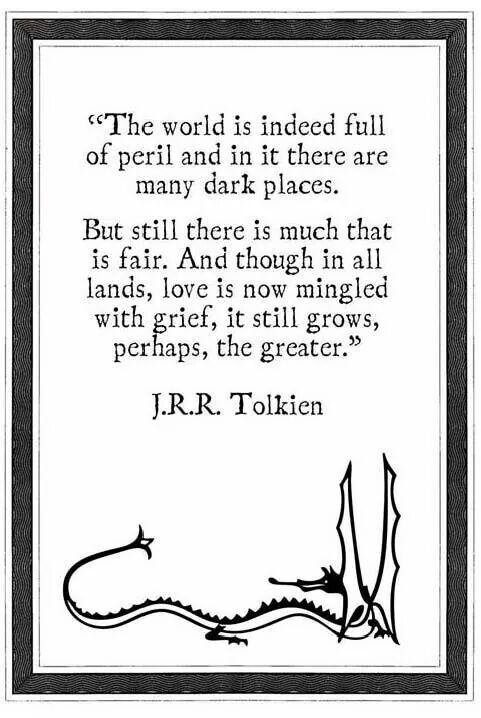
Grief TolkeinHe served his country in the Royal Australian Navy as a Petty Officer Writer. He survived the bombing of Darwin, he was present at the Japanese surrender in Toyko Bay. He seldom spoke of the war.

He was handsome, charming and dapper.

He was twice divorced and thrice married. He endured the slings and arrows of outrageous fortune, many of them aimed (understandably) by my grandmother and many more, I suspect, directed by himself.

Above all, he was a man of love. His hugs were like being wrapped in a warm blanket on a winter’s day. He was bighearted. He was generous to a fault. He was a blazing sun, full of love and light.

During his life he was not an angel, but I’d like to think that he is one now.

Teething Problems

Rooftop BalletMarvel Girl lost her first tooth last night.

It was always going to happen sooner or later — later, in Marvel Girl’s case — but like many of life’s milestones, I am never as ready for these things as I think I’m going to be.

In the midst of her excitement, her jubilant preparations for the impending arrival of the Tooth Fairy (not to mention Miss Malaprop’s massive meltdown at the sight of her sister’s bloodied mouth), I felt torn between sharing the intensity of her joy and the old familiar tug of…of…of that feeling for which we have no adequately descriptive word in English.

It’s a blend of something like nostalgia, sometimes tinged with regret, but somehow resurrected by pride.  It’s born of the knowledge that my Marvel Girl and her sister are growing up.  And it’s inevitably followed by a rushing reminder of Gretchen Rubin’s ever so accurate observation that “the days are long, but the years are short”.

The Portuguese, bless them, have a word for this feeling, or something very like it: Saudade.

“Saudade” translates, to the best of my knowledge, as “a nostalgic longing to be near again to something or someone that is distant, or that has been loved and then lost”, or as Anthony de Sa puts it, “a longing for something so indefinite as to be indefinable”.

I feel saudade most acutely in those moments when part of me recognises, at some deep and otherwise undetected level, that after this, things will never be the same. These are the occasions when I feel that I am bearing witness to life — most frequently, for me, to the lives of my daughters. These are the moments that are captured by my heart’s camera, imprinted between heartbeats, indelible impressions of life most raw and pure.

You can get a free printable of this quote here.

You can get a free printable of this quote here.

I watched my Marvel Girl’s spontaneous dance of joy last night, her tiny tooth held tight between her fingertips, thrust up towards the light, and I knew the moment for what it was.

I won’t forget it, just as I won’t ever stop reminding her how much I love her, or how much she loves to dance.

And when I confessed to a dear, dear friend today that I was still feeling torn between saudade and sweet delight, he reminded me, ever so gently, that there was never ever any going back.

There is only the moment, to enjoy as much as is humanly possible.

If you have enjoyed this post from Blue Jai and would like musings delivered from the daydream believer to your inbox whenever they appear, you can follow this blog via email by clicking the link at the top right hand corner of this page.

So Hot Right Now…

Syd Sunset 2Summer is coming to a close. It’s February…season of sweats and humid yucky-ness. Had John Keats been around to write about the end of an Sydney summer he would probably have been even more florid in his praise of autumn.

It’s funny — summer is something we long for, but by the time Australia Day has rolled around and we’ve yelled kung hei fat choi as fireworks burst against the backdrop of an eventually darkening daylight-savings sky, we’re slightly over it. Not the long evenings of sunshine and endless twilight, not the many happy hours at the beach, nor the impossible stretch of bleached blue skies that pilots refer to as “severe clear”.  No, those things we’re happy to embrace, to celebrate, and — come July — to immortalise.

It’s the humidity.

Humidity, that drooping, relentless, monsoonal wet blanket. Those never-ending February days filled with hot, moist air dampening all that it touches, followed by nights when the temperature does not dip below a balmy 23 degrees. Nights when bedclothes are abandoned, and sheets become stained with sweat.  My children sprawl across their beds, legs and arms flung into starry shapes as they sink into turbulent sleep, disturbed by short, sharp bursts of rainfall on the roof.  In our own bed my husband seems somehow distant from me, separated as we are by the contorted, constricting snake of doona, squished between our torpid, somnolent forms.

And then there are the really hot nights, when all the old stories come out: tales of being taken to the beach in what felt like the middle of the night to splash in the shallows and cool down.  Of nights when the heat defeated any prospect of sleep, and people sat around having a quiet yarn and maybe the odd beer, and everyone knew that the occasional “How hot is it?” was not even a rhetorical question, but an admission of surrender.

The word “humid” is actually derived from an old French word for “moist” or “wet”, but is probably influenced also by the Latin word “humus”, meaning “earth”.  It’s remarkable accurate, really, because that is what it feels like, this Sydney heat — moist earth.  And it smells like overblown frangipani flowers, trodden into the mouldering undergrowth.  It wilts us, saps us of our energy, sends us to our knees. We droop in ancient deckchairs, waiting for the southerly winds to blow in and trace cool fingers across our brows.  We know, only too well, that the humidity won’t last, and neither will the summer.

Yes, here in Sydney, summer is coming to a close.

I Stand For Mercy

It’s a glorious day in this part of the world today — the sun has made a robust reappearance and a strong breeze is blowing away the clouds that dumped a month’s worth of rain on Sydneytown in two long grey days.  Kids are heading back to school, and daily life seems like it’s on the verge of resuming its usual reassuring rhythm.

But there’s something tugging at my conscience, and I believe that I must speak out and tell whoever is prepared to listen that I stand for mercy.  

I stand for mercy for the ringleaders of the so-called Bali Nine, Myuran Sukumaran and Andrew Chan. I do not wish to go over the ins and outs of Sukumaran’s and Chan’s case, save to say that I readily acknowledge their guilt and I strongly believe that they should serve their time for the crimes they committed.  I am not attempting to excuse their conduct, nor to endorse drug trafficking in any form.

That said, I do not believe in the death penalty.

Regardless of a person’s crimes, however horrific, I do not believe that any human being has the right to take the life of another.  I didn’t believe it as a ten year old, hearing the Barlow and Chambers case being reported on the radio, and I don’t believe it now.

What I do believe is that “everyone has the right to life, liberty and security of person”, as stated in Article 3 of the Universal Declaration of Human Rights.  I am proud to live in a country that is not only a signatory to that Declaration, but was also one of eight nations involved in its drafting.

I recognise that speaking out and making a fuss is, in all honesty, probably not going to achieve a great deal, particularly given that Indonesia has already executed six other individuals (five of them foreign nationals) this year, all of whom had been convicted of drugs charges.

But I can only hope — even if it be but a fool’s hope — that by lending my voice to the growing chorus of other voices in Australia and around the world, that Sukumaran and Chan just might be allowed to live out the rest of their days in an Indonesian prison rather than being transferred to Nusa Kambangan island, woken in the middle of the night, taken to a remote location, and shot dead by a firing squad.

And so I say: I stand for mercy.

Mercy

Fudge and the Foo Fighters

My nerves have been a little jangled lately.

Perhaps it’s the slightly manic time of year.  Marvel Girl and Miss Malaprop have been veering wildly — and not always simultaneously — from being whingey and tired to such dizzying heights of raucous excitement (provoked, no doubt, by the impending arrival of a certain Mr S Claus) that I have already instituted a household-wide ban on the consumption of candy canes.  The Bloke is trying to get it all done before the office shuts down over the holidays, all while contending with the whirl of Christmas parties that is now in full (and sometimes drunken) swing.  I’ve been making and revising endless lists and menus and timetables in preparation for hosting The Big Day for the second year running thanks to my brother’s late-running house renovations, and trying to recall exactly where I have stashed all those presents…

Or maybe it’s the weather.  The drooping humidity.  The cracking thunderstorms that have rolled through from the west every day or night for the past week, jarring me out of sweaty slumber into an electrified state of high alert: will the kids sleep through, despite the sky being filled with such incandescent light and percussive rage?  I suspect I greeted the southerly change that finally blew in so sweetly yesterday evening with more reverence than I’ve shown to just about anything else since the season of Advent began.

And then I realised that in the midst of all the atmospheric disarray and my attempts to wrangle organisation from impending chaos, to keep two children provided with proper nourishment and uninterrupted sleep, and to assist a husband who — with his business partner fighting cancer since February — has experienced one of the most challenging years of his career, that I had completely overlooked something that, for me, is really important: I had forgotten to write.

So here I am again.  Showing up on the page.

Making sure that today, I have gone back to my First Principles: words, music, food.  To pay homage to my own holy trinity of creative pursuits and their sustaining presence in my life.

I made chocolate walnut fudge while listening to the Foo Fighters’ fifth album, In Your Honour.  It seemed like an appropriate soundtrack to my seeking refuge in what Nigella Lawson calls “the solace of stirring”.  After all, making fudge is a calming, mellowing, meditative process — even if I did, perhaps perversely, choose to play the heavier of the album’s two CDs while the sugar slowly caramelised in the saucepan.  (Watching an episode of Sonic Highways recently I was startled to realise that after all these years The Bloke is still coming to terms with the fact that he married a girl whose musical tastes could be best described as disparate, and who genuinely likes it loud.)

Dave GrohlAnd so, this afternoon, my kitchen became my cathedral.  I stirred and sang along with Dave Grohl to “The Last Song” and sorted through my thoughts before sitting down here at the keyboard:

This is the sound
The here and the now
You got to talk the talk, the talk, the talk
To get it all out…

The jangling has gone, and I’m grateful.  Not just because I finally went back to how I roll.

I remembered to let it rock too.

Swallows and Amazons Forever!

SwallowdaleThere were shrieks of excitement at our place last week when we arrived home to discover a flat brown cardboard box on the front doorstep.  Now, my kids have both wised up to the fact that there are really only two things that get delivered to our house with any regularity, and since this carton was not big enough to contain a dozen bottles of wine, they immediately deduced — correctly — that this box contained an equally precious cargo: books.

“SWALLOWDALE!” yelled Marvel Girl, elated.  When given the choice between a sparkly ice-blue Elsa dress and the second installment of Arthur Ransome’s Swallows and Amazons series, my darling girl — bless her — picked the book.  For me, her choice speaks volumes (if you will please, please pardon that dreadful pun).

Swallows and Amazons and the series of books that follow it were first published in the 1930s.  They recount the adventures of the Walker and Blackett children during their summer holidays, first in the Lakes District of England and subsequently in other parts of the world.  Much of the action involves sailing — in dinghys named Swallow and Amazon, hence the title — camping, and a great deal of outdoor exploring and imaginative playing.

My parents read these books (yep, all twelve of ’em) to me and my younger brother when we were children.  At that time the stories were already more than half a century old and evoked an obviously bygone era, but they still motivated us to embark on a variety of nautical escapades.  The most memorable of these took place on a particularly windy day at Narrabeen Lakes, when my mother and I were careening so quickly — or maybe even recklessly — through the water in the family’s trusty Mirror dinghy (both of us high on adrenalin and the rush of freedom every sailor knows and loves) that my father, waving his arms in consternation on the sandy lake’s edge, turned as crimson as our tiny boat’s sails, while my brother fell about laughing watching the combined on-shore/off-shore spectacle. Our other adventures took place on a slightly grander scale on my Grandpa’s yachts, first Aphrodite and later Saracen II (who was built for speed had competed in seven Sydney to Hobart races), before increasing age finally forced my sea-faring grandfather to stow away the sailcloth, and we all putted about Pittwater with him on a Halvorsen cruiser called Chloe.

Strangely enough, The Bloke spent half his childhood on the water too.  His father remains a keen sailor and still races his yacht twice a week, despite being well into his seventies.  More significantly, however, The Bloke’s dad also built a Pirate Boat (from scratch, in his garage) for Marvel Girl, Miss Malaprop and their cousins, and even took the time to outfit this marvelous vessel with a mermaid Barbie figurehead and a bespoke Maltese Cross-bearing sail.  Watching his grandkids sailing about, every last one of them bedecked in a life jacket and pirate hat, brings a huge smile to his face — and to that of anyone else watching that little dinghy tack about the shallows with the Jolly Roger flying atop its mast.

I suspect that Marvel Girl’s own piratical capers have contributed enormously to her taking to the Swallows and Amazons series like a certain proverbial duck…that, and the fact that even though this is only her first year of school, she is loving reading.  She is, apparently, the second best reader in her class (a fact that she is nearly as proud of as her mother is).  When she emerged from her latest school assembly clutching a merit award praising her fluent and expressive reading, the spontaneous fist pump and grin of utter triumph she gave when she saw me in the playground more than made up for the fact that I wasn’t there to see her get the certificate.

But an equally big thrill for us both, and for Miss Malaprop, too, is that there are eleven — yes, eleven! — more books in the Swallows and Amazons series for us to read together.  I will enjoy reading my girls the stories of John, Susan, Titty and Roger (the crew of Swallow) and Nancy and Peggy (the Amazon pirates) and their summer holiday

Swallows & Amazonsadventures — even though there is no way I would ever let my own children camp, completely unattended, on a small island in the middle of a lake for over a week.  (More to the point, I suspect any parent remiss enough to do so these days would be reported to the relevant authorities faster than you can say “Child Protection Officer” or “Lord of the Flies“.)

But I am looking forward to re-visting that age of innocence which, although lost, lives on in print.  And I can think of no better way to spend our own summer holidays than revelling in the tales of theirs.

Swallows and Amazons forever!