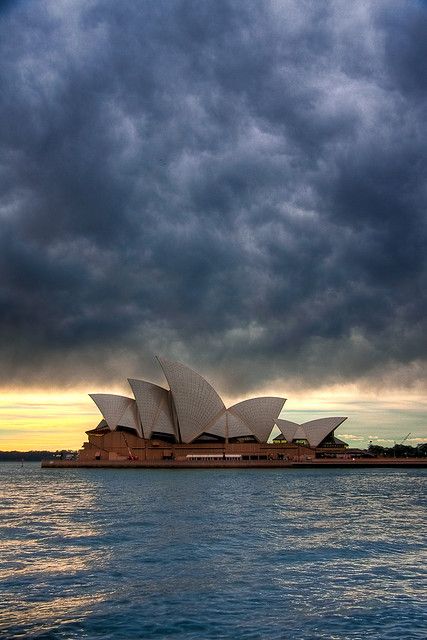
Jacaranda Dreaming

Jacaranda Trees...these ones are near The Bloke's work.

Jacaranda Trees…these ones are near The Bloke’s work.

It’s Jacaranda season in Sydney — signalling the time of year when our city begins the swing into summer and lets loose its inner show off. All around this harbour town the treeline is splashed with blossoming bursts of colour, and before too long the streets will be carpeted in thousands of impossibly blue petals.

The Jacaranda tree (Jacaranda mimosifolia) is not native to Australia, but like all good things from not-so-distant places — Phar Lap, the Finn Brothers and Russell Crowe immediately spring to mind — we’ve claimed them as our own. The trees are actually of South American origin, and the word “Jacaranda” was first described to the English speaking world in the first edition of A supplement to Mr. Chambers’s Cyclopædia way back in 1753, more than thirty years before The First Fleet even arrived at Farm Cove. But claim them we have, and their spectacular blossoming in late October or early November each year heralds the coming of our splendid sub-tropical summer and, for many Sydneysiders, often triggers other memories as well.
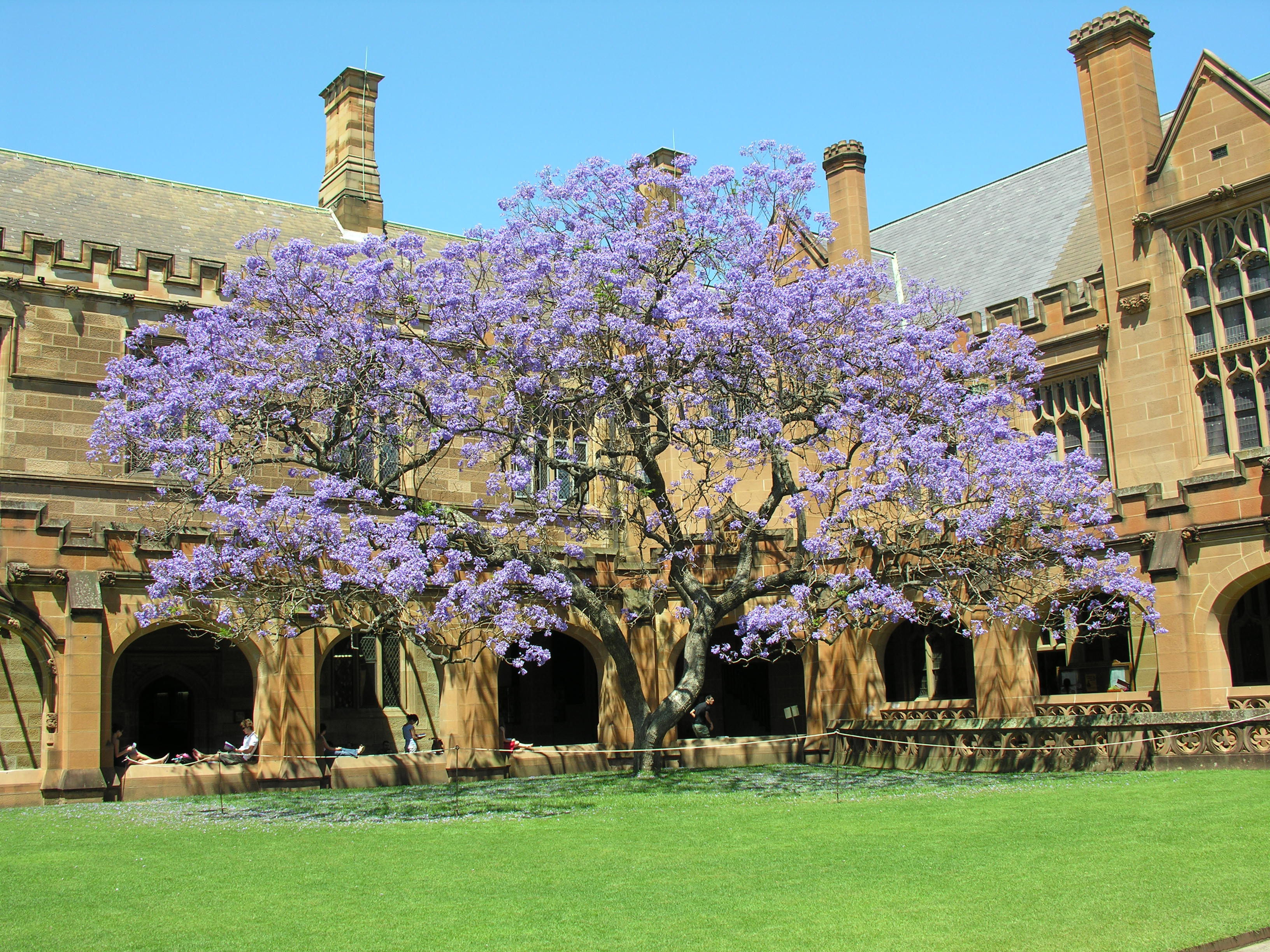
The famous Sydney Uni Jacaranda (1927-)...it holds a special place in my heart, and that of many other alumni.

The famous Sydney Uni Jacaranda (1927- )…it holds a special place in my heart, and that of many other alumni.

One of the most famous Jacarandas in Sydney stands in the Quadrangle of Sydney University, my alma mater and my father’s as well. The tree was planted in 1927 by E G Waterhouse, a professor of comparative literature who also popularised the growing of camellias in many Sydney gardens. University folklore has it that if you haven’t started studying for your exams before the Jacaranda blooms in the corner of that incredible Gothic quad, then you’re doomed to fail.

My memories of the Sydney Uni Jacaranda are overwhelmingly positive: the cloisters beneath the tree were a beautiful place to sit and read, to soak up the atmosphere, or to feel the palpable sense of history that pervades those elegant sandstone buildings. There were days when we would sprawl beneath the blossoms before lectures, unperturbed by the “Keep Off The Grass” signs, secure in the belief that they couldn’t possibly apply to us. And if we were asked to move — well, it was probably time to get to tutorial anyway.
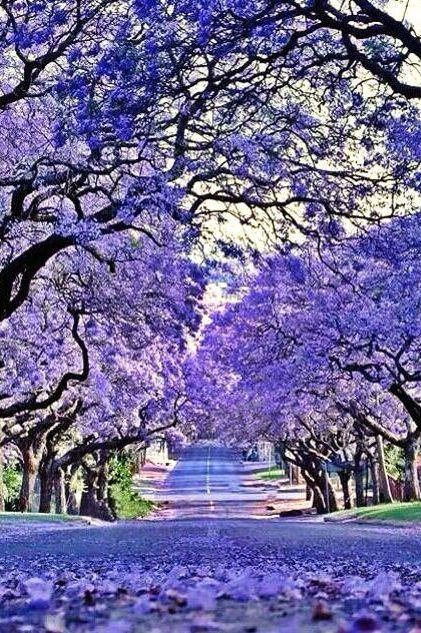
Jacarandas in Grafton, Northern NSW

Jacarandas, Grafton NSW

My other Jacaranda memories are much older.  As a child, a giant Jacaranda tree grew outside my second-storey bedroom, and every November the blossom-laden branches outside my window transformed my room into a lilac bower. It was easy to believe in flower fairies looking out into that spreading canopy of mauve and blue. I was utterly heartbroken when the tree grew into the sewer line and had to be removed. They are, after all, spectacularly beautiful trees.

Nowadays, I get my Jacaranda fix wherever I can: there’s a gorgeous one at Marvel Girl’s school, and you see plenty just driving around the neighbourhood. I wish I could plant one in our own yard, but our narrow Northern Beaches block doesn’t have the space for such a specimen. And besides, I still have those special trees — those of my childhood memories and my student days — and they will stay with me forever.
Lux Veris

Spring 2015 021

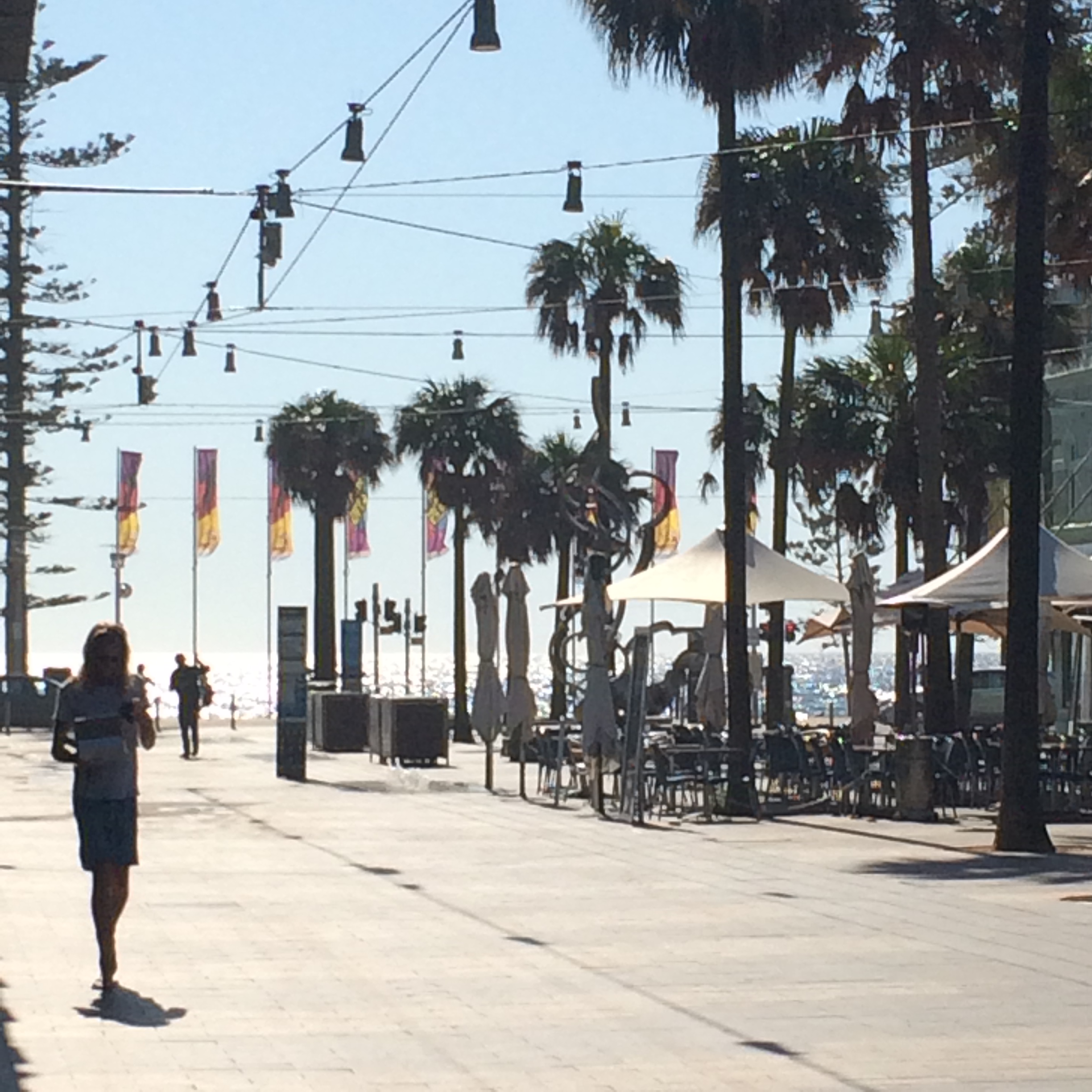
Morning on the Corso…this is Spring in Sydney

I love the light at this time of year, when bleached skies and metallic seas signal the onset of Summer. There is something uniquely Australian about the quality of that light: an intrinsic brightness with a shine and sheen that we recognise — instantly — as being the light of our homeland.

Pilots call it ‘severe clear’, a term used to describe conditions of unlimited visibility, but it’s a remarkably accurate expression. There is nothing subtle about the light in the Antipodes: here the sun blazes, the heat blinds.

In Sydney we appear to have skipped straight past Spring, with the temperatures in recent days soaring into the thirties. Around here, the beaches have been packed and the Manly Jazz Festival has been in full swing. It’s great weather for jazz, and for Jamiroquai too. While Winter might make us head for the mellow tunes of Milky Chance, Spring and Summer have us cranking up the car stereo, and reaching for Robin Schulz and Ministry of Sound Annuals. At this time of year my rear view mirror often provides glimpses of Marvel Girl busting out her best dance moves (quite a range, considering the confines of her car seat) while Miss Malaprop sings along — in her own words, as usual — thinking she can rap just as well as Nicki Minaj (she so can’t).

It’s been fantastic weather for footy, too, with last Sunday going down in the history books as a golden day in Australian sport: first the Wallabies won at Twickenham and sent the hapless Poms packing out of the Rugby World Cup, and then the North Queensland Cowboys took home their first NRL premiership in spectacular fashion with Johnathan Thurston kicking them to victory over the Brisbane Broncos with a field goal in extra time. It was a Grand Final for the ages, and one I won’t forget.

But then again, the October Long Weekend always has a touch of enchantment about it, because every year at 2:00am on the first Sunday of October, a magical thing occurs: Daylight Saving Time begins. Well, that is to say, it begins here in New South Wales, Victoria, South Australia, the Australian Capital Territory and Tasmania — for some obscure reason (still unknown to the rest of the states and territories along the Eastern Seaboard) Queensland doesn’t participate. To be fair, they always have done things a bit differently up there…though not even I am game to mention the Bjelke-Petersen years…

Still, for the rest of us, the beginning of Daylight Saving Time means longer days and lingering twilight. It means trips to the beach after school, it means barbecues and a few quiet beers at dusk. And for a lot of Australian kids, it means going to bed when it’s still light.

Strangely enough, some of my most vivid childhood memories are of lying beneath my window in my bed as the golden light of day slowly faded into the deep tropical green of evening. I can still hear the last raucous squawks of roosting lorrikeets, and the rhythmic thunk of the filter in the neighbours’ pool after someone popped in for one last swim. I can still see the inky silhouettes of trees on the horizon, and the first twinklings of the stars high above. Only when I had seen the Southern Cross wheel its way above my head would I close my eyes and sleep, secure in the knowledge that I was truly home.

Ahhh…that light, again. Severe clear by day, warm and inviting by night. And while Dorothea Mackellar may be justly famous for summing up what Australia is like in “My Country”, I think — oddly enough — that it was Wordsworth who understood just what I experienced as a child, even if he felt it a few miles above Tintern Abbey instead of in Sydney:

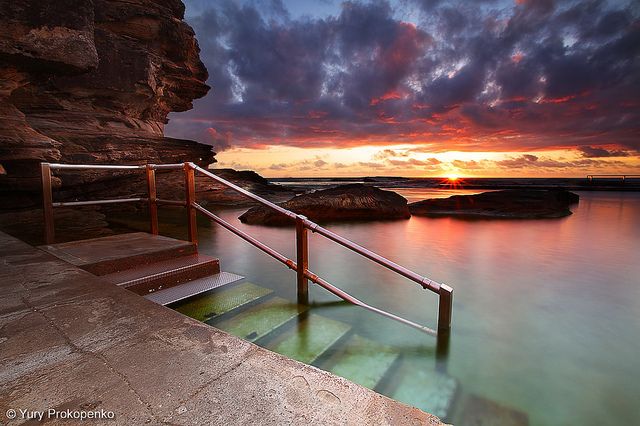
My local rockpool...photo credit Yury Prokopenko

My local rockpool…photo credit Yury Prokopenko

         …And I have felt
A presence that disturbs me with the joy
Of elevated thoughts; a sense sublime
Of something far more deeply interfused,
Whose dwelling is the light of setting suns,
And the round ocean and the living air,
And the blue sky, and in the mind of man;
A motion and a spirit, that impels
All thinking things, all objects of all thought,
And rolls through all things.


A Winter’s Tale

Southern CrossThe Winter Solstice has just slipped past down here in the Southlands, and with it the shortest day.  It’s about as cold as it ever gets in Sydneytown, when the sun dips down before dinnertime and the stars swing overhead in the early darkness, pricking tiny silver holes in frosty skies.  The Southern Cross shines brightest in the winter sky.

Winter.

Some say we don’t know much about winter, down here in the Antipodes. It’s not like we need to don down jackets just to pop out to the shops, and any child sporting a pair of earmuffs is probably impersonating Anna from Frozen rather than protecting their extremities from the cold. But having spent two years living in Canada, in a city on a more northerly latitude than Moscow where winter lasted the better part of eight or nine months, I can honestly say I have felt colder in Sydney than I ever did in Edmonton.

Sydney cold seeps.

Sydney stormIt gets into your bones. It is dank and it is damp. It rides in on southerlies, straight off Bass Strait, and settles into every exposed crevice. It saps and it leaches. It is persistent.

Winter weather in Sydney is a petulant child: sunny one moment and sulky the next, or threatening to storm before suddenly showing off, throwing ridiculously perfect rainbows and breathtaking beautiful sunsets skyward as twilight descends. It makes us stamp our feet and rub our hands, yet takes great delight at seeing our breath emerge in great clouds of white when we speak into the chill.

In wintertime, we seize the days of sunny splendour that remind us that summer does return to our city, we grasp them and will them to last.  We retaliate against unexpected rainstorms by buying yet another umbrella when the weather catches us out. Again.

But when the wind blows and the temperature drops, we often retreat.

As Edith Sitwell once said, “Winter is the time for comfort, for good food and warmth, for the touch of a friendly hand and for a talk beside the fire: it is the time for home.”

In WinterIn winter, we wrap our fingers around warm cups of tea. We roast and we slow cook. We bake. We pull portable heaters out of their hiding places. We wear ugg boots anywhere we think we can get away with it, and even in some places where we can’t. We curl up with books under blankets. We indulge in marathon Netflix sessions. We curse the fact that Season Three of Crossing Lines is still in post-production because we’re running out of episodes of Tom Wlaschiha…er, sorry, of Season Two…

And, somewhere in the midst of all our burrowing under covers, swapping recipes for soup, and muttering the motto of House Stark, there comes a point when Sydneysiders start to smile. It’s a strange and subtle tipping point, that begins with a slight upturning of the corners of the mouth, and usually ends up resembling a smug grin.

Because the secret to surviving a Sydney winter is very simple: all you need do is remember that around here, winter doesn’t last all that long.

And, besides, as Anton Chekov said: “People don’t notice whether it’s winter or summer when they’re happy”.

So Hot Right Now…

Syd Sunset 2Summer is coming to a close. It’s February…season of sweats and humid yucky-ness. Had John Keats been around to write about the end of an Sydney summer he would probably have been even more florid in his praise of autumn.

It’s funny — summer is something we long for, but by the time Australia Day has rolled around and we’ve yelled kung hei fat choi as fireworks burst against the backdrop of an eventually darkening daylight-savings sky, we’re slightly over it. Not the long evenings of sunshine and endless twilight, not the many happy hours at the beach, nor the impossible stretch of bleached blue skies that pilots refer to as “severe clear”.  No, those things we’re happy to embrace, to celebrate, and — come July — to immortalise.

It’s the humidity.

Humidity, that drooping, relentless, monsoonal wet blanket. Those never-ending February days filled with hot, moist air dampening all that it touches, followed by nights when the temperature does not dip below a balmy 23 degrees. Nights when bedclothes are abandoned, and sheets become stained with sweat.  My children sprawl across their beds, legs and arms flung into starry shapes as they sink into turbulent sleep, disturbed by short, sharp bursts of rainfall on the roof.  In our own bed my husband seems somehow distant from me, separated as we are by the contorted, constricting snake of doona, squished between our torpid, somnolent forms.

And then there are the really hot nights, when all the old stories come out: tales of being taken to the beach in what felt like the middle of the night to splash in the shallows and cool down.  Of nights when the heat defeated any prospect of sleep, and people sat around having a quiet yarn and maybe the odd beer, and everyone knew that the occasional “How hot is it?” was not even a rhetorical question, but an admission of surrender.

The word “humid” is actually derived from an old French word for “moist” or “wet”, but is probably influenced also by the Latin word “humus”, meaning “earth”.  It’s remarkable accurate, really, because that is what it feels like, this Sydney heat — moist earth.  And it smells like overblown frangipani flowers, trodden into the mouldering undergrowth.  It wilts us, saps us of our energy, sends us to our knees. We droop in ancient deckchairs, waiting for the southerly winds to blow in and trace cool fingers across our brows.  We know, only too well, that the humidity won’t last, and neither will the summer.

Yes, here in Sydney, summer is coming to a close.