
The Curse of Inigo Montoya

I was driving my elder daughter to school this morning when Marvel Girl made the unexpected announcement that she had watched The Princess Bride again last night. As someone who has watched that film approximately eleventy-six times, I was filled with a warmish sense of maternal pride. I say warm-ish because it was precisely eleven degrees and blustery outside (and that, as any self-respecting Sydneysider knows, is what we proclaim around here to be cold — along with any other celsius temperature reading that fails to begin with the number 2 and is followed by another digit).

I am still unsure what prompted Marvel Girl to take another look at one of the favourite films of my childhood, and as a result have been afflicted ever since I dropped her off by what I am now grandiosely (and ever so slightly theatrically) referring to as the Curse of Inigo Montoya.

Although Inigo’s more famous and oft-quoted line in The Princess Bride features him introducing himself and then advising his foe that they should prepare to die (in what some have described as a masterclass in effective networking), I believe another of his classic statements is entirely more relatable and have thus co-opted it to form the basis of said Curse.

Even if you’ve only seen the movie once, you know the line:

I hate waiting.

See? TOTALLY RELATABLE. I defy you to present me with a single person on the planet who actually enjoys waiting. Even though waiting is something we all have to do — it could even be said to be a defining feature of the human condition — I genuinely believe the person who finds waiting pleasurable is about as rare as say…oh, I dunno, someone with six fingers on their right hand?

Waiting SUCKS.
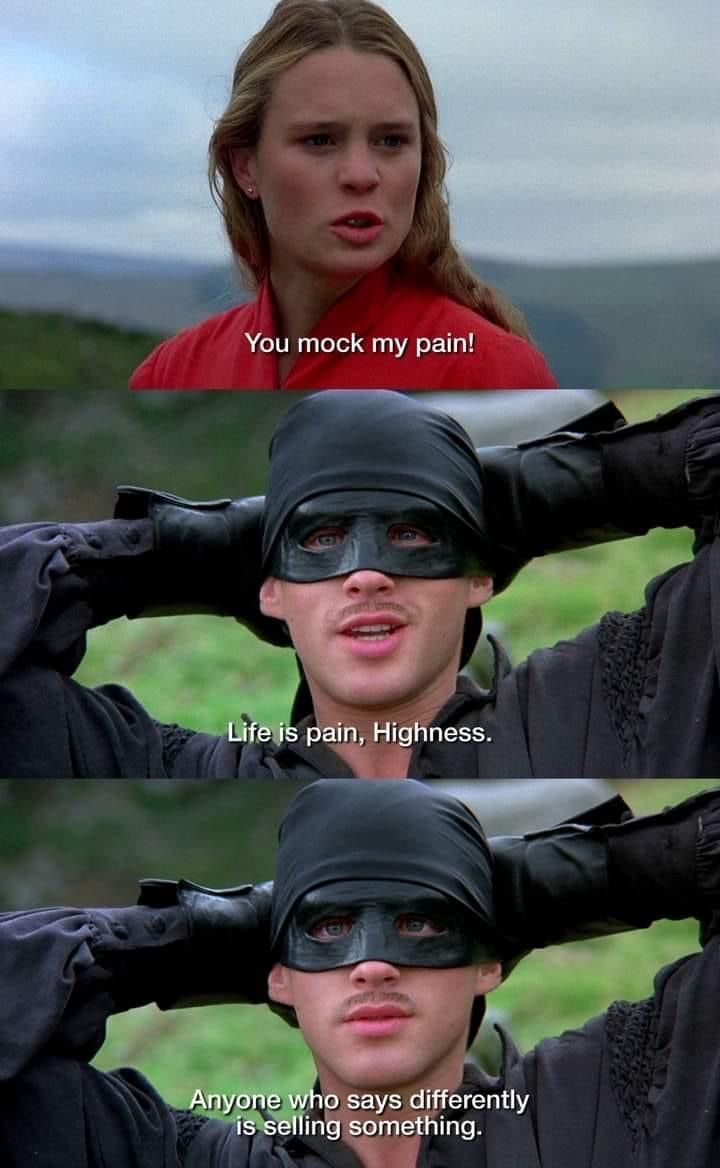
Anyone who has held on for any kind of meaningful response (and I include this category everything from academic scores, job applications, marriage proposals and — probably worst of all — medical test results) knows how agonisingly dreadful waiting is. Samuel Beckett clearly knew all about it: Waiting for Godot goes exactly nowhere yet somehow keeps audiences riveted to their seats.

The slippery, torturous and endlessly annoying thing about waiting, you see, is that the tantalising promise of some kind of result or outcome forces us to endure the unbearable space between.

I wrote a while back about the liminal places in our lives when I was in the process of finishing my novel. But now, now that I have shepherded my words onto the page and guided them into the hands of a prospective publisher, I am back in that space between again. This is not nearly as simple as waiting for Marvel Girl to get home to ask her why she watched The Princess Bride again (and to apologise for forgetting to ask her how her English exam went yesterday — yet another maternal fail). The stakes feel so much higher and, depending on the day, they are tangled up with words like worthiness and success and the unthinkable opposites of those.

This, my friends, is the Curse of Inigo Montoya.

And yet, The Princess Bride gives me hope.

Inigo Montoya, though cursed to wait, never gives up. Buttercup never stops loving Westley. Miracle Max somehow finds a way to pull off a marvellous death-defying feat. The baddies (even the Rodents Of Unusual Size) get beaten, the goodies rescue the princess, true love prevails, and the world now knows the true meaning of the phrase, “As you wish”.

It’s all quite heartening, really.

Waiting is giving me the opportunity to tinker here, in my little patch of cyberspace, for the first time in months. It’s allowing me to read books occupying the same genre I write (which I tend to avoid when creating to avoid becoming at all derivative), to listen to podcasts I wouldn’t normally have time to (which led this morning to me snort laughing when I heard the enormously intelligent and wickedly funny Marina Hyde describing the long-feuding Cyrus family as “Tennessee Lannisters”), to plan extensively detailed holiday itineraries, to cook things I haven’t made for ages or haven’t ever made — the list goes on and on and on — and all because waiting, much as I find it utterly and completely maddening, waiting gives me the space and time to do all these things.

Turns out the Curse of Inigo Montoya may be a blessing in disguise.

And so, my friends, whatever you find yourself waiting for, may you find Inigo’s Blessing rather than his Curse.

Mind yourselves,

BJx

Swashbuckling Swag

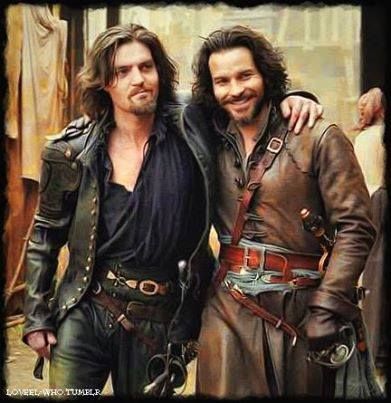
Athos & Aramis

Tom Burke & Santiago Cabrera as Athos and Aramis in The Muskeeters.

For some peculiar reason, I had a recollection this morning of the day, some years ago now, when Marvel Girl (repeatedly) singing a Wiggles song about Captain Feathersword prompted Miss Malaprop to stomp into the kitchen and announce: “Pirates aren’t human — that’s why they can’t swim.”

I remember suggesting at the time that this proclamation was, perhaps, not entirely accurate, only to be fixed with a mutinous greeny-blue eyed gaze and told even more emphatically, “Well, pirates do swashbuckle, you know — that means they don’t wash.”*

That was the point, I suspect, when I changed the topic of conversation, swiftly applying Blue Jai’s First Rule of Parenting (Distraction), and no doubt reminding myself of the corollary to said Rule (which is, of course, Pick Your Battles).

But the memory of that encounter made me realise that my girls, like many other children the world over, have always been fascinated by that wonderful figure of daring and romance: The Swashbuckler.  And — let’s face it — there are plenty of adults out there who still enjoy a tale or two of heroic derring do too.

Athos & Honour

No glory, no money, no love, none of the things that make life bearable — except honour.

What’s not to like about a hero who has plenty of good, old-fashioned adventures, tackling all manner of dangers with bravado and — more often than not — with a sword? And I’m not just referring to The Princess Bride here folks, or Johnny Depp’s hilarious take on Captain Jack Sparrow in the Pirates of the Caribbean movies. Seriously — does anyone really think that Game of Thrones would be half as successful as it is were it not for its dashing ensemble cast of heroes and idealists, all brandishing weapons of warfare from centuries past?

Nothing beats the flamboyance of a decent sword fight, full of flashing steel and sophisticated steps, not to mention swirling capes (and don’t think for a minute that the capes are not important: every proper superhero has one). And, in this day and age, I suspect our fascination with the Swashbuckler isn’t simply an escape or a diversion, it’s something more important.

Take the recent BBC production of The Musketeers, for example. Admittedly, the Musketeers are by definition the original Swashbucklers, and have been ever since Alexandre Dumas brought Athos, Porthos, Aramis, D’Artagnan and Captain Treville to life on the pages of his novels in the 1840s. But I don’t think it is any accident that The Musketeers has proved to be so popular, or that the show’s loyal fans around the globe are eagerly awaiting the premiere of Season Three.

Athos & D'Artagnan

Taking the easy way out? Or taking responsibility…

My suspicion is that in this self-obsessed day and age of the quick fix we want to remember the ideals of a bygone era, and not necessarily for rose-coloured or romantic reasons. We want to be reminded of the concepts of chivalry, of honour, of duty. We want to believe that the famous rallying cry of “All for one!” can drown out the far more commonly heard call of “every man for himself”.

And the Musketeers — consistently — deliver. In every episode, we see them strive to set aside their own aspirations and take responsibility for doing things because they right and just — not because they will bring them personal gain. Time and again they are required to rise above their individual flaws, their respective personal circumstances, and the ever-present temptation to take the easy way out against a parade of brilliantly cast villains — not least of whom is Milady de Winter (Maimie McCoy), Athos’ evil estranged wife.

To date, the Musketeers have confronted the scheming Cardinal Richlieu in Season One (played with class and sass and a whole lot of cape swirling by the inimitable Peter Capaldi), followed by the increasingly unhinged Spanish agent Rochefort (Marc Warren) in Season Two, and are set to tackle King Louis XIII’s illegitimate half-brother (Rupert Everett) in Season Three.

It doesn’t hurt — obviously — that the Musketeers are a bunch of good-looking leather-clad blokes who ride around on horseback saving the day in brilliantly choreographed fight scenes, and that the women they love are often as as brave as they are beautiful. But the Musketeers do help to remind us that chivalry does not have to be a forgotten ideal of days gone by, and that doing what is honourable or dutiful can be something worth aspiring to.

So let’s celebrate the Swashbucklers and their stories, too.  Let’s live like daring adventurers, and revisit the romance of a bygone age. And if, along the way, we are reminded of the (somehow higher?) standard of those times — of the ideals of chivalry, honour, duty, loyalty and sacrifice — is that such a bad thing?

My thought is that the Musketeers generally, and Aramis especially, would suggest that applying yourself to such ideals tends to produce positive results — particularly if you do so with a robust sense of humour and a serious amount of swag.

Musketeers

Celebrate the Swashbucklers! Aramis, Porthos, Captain Treville, Athos and D’Artagnan…the Musketeers.

* For the record, I should probably acknowledge that Miss Malaprop’s assertion that “swashbuckling” means “not bathing” is probably historically accurate, even if it is, as a definition, far from complete.